 gurupanguji
🔗 The Copy and the Guru
The more I think about it, the more I realize this is the ultimate expression of what began in the social media era, when media manipulation became the primary currency instead of authenticity. We all created curated, and often false, lifestyles on Instagram.
Social media gave us tools to edit our lives into a highlight reel. Photos of coffee, food, selfies from places you couldn’t afford last year, some pithy comment. It was all one directional. A movie about me, by me, for me to broadcast and you to watch. This is what led to the rise of influencer culture, where anything and everything was for sale. The self first became a gallery, then a reel. It was all passive, beautiful, controlled and fake.
We shared bumper sticker wisdom on Twitter. LinkedIn became a public square to hawk faux expertise. This popsci compression of complex thinking into shareable nuggets, designed for distribution and optimized for engagement, was the next step in the self becoming a product.
The pseudo-conversation twin is the crescendo. The self’s full immersion into illusion is now interactive. It answers questions. It gives the impression of encounter, of dialogue, of relationship. But it is still the same curated self with a conversational interface bolted on. It is as authentic as a Potemkin village. And with every step we have moved further from the actual person. The twin is not a rehearsal. It is the first act of abstraction of ourselves. Reid AI can do the job from a bunker in New Zealand.
Source: The Copy and the Guru
Oh come on, not Om!
Look around and all you can see are gurus under their proverbial banyan trees, who make nothing but impart wisdom. They listen to the same podcast, and then regurgitate. They marvel at humanist manifestos. Some even read the Stoics. This is found wisdom, not earned wisdom. The twin is only possible once you have stopped being accountable to reality. The code either runs or it doesn’t. The piece either lands or it doesn’t. That accountability is what keeps thinking honest. Once you move from doing to narrating, you can be archived. Once archived, you can be distributed to the rest of the planet.
Source: The Copy and the Guru
The digital twin is just more of the same masquerade. It once again comes from the same impetus: there’s more efficiency to be gained (lower self worth) or more gyaan to be extracted (higher self worth) from the “human” you. It also buys into the core logic that “language = intelligence.”
Personally, I think this also a sign that we’ve somehow warped our brains into thinking that being “human” is somehow - less. The our output is the only way to value us? That we should even value us?
Om connects it as an extension of the social media masquerade act we’ve been training ourselves and putting on for the last decade or so.
Personally, I find the entire field fascinating: It’s filled with contradictions. There’s this optimistic take that by removing the “grunt work” from humans on to clankers, humans get to do more higher order / level thinking.
I will be honest and say that human adaptation seems to suggest that the “higher level thinking” that we seem to appreciate more and find more valuable, will become grunt work by us doing more of that. I will be happy if/when I am proven wrong. I am also in this experiment together with everyone.
Maybe it’s just a matter of timing and we are all in the path of migration from lower-order tasks to higher-order tasks. However, throughout history - we’ve needed darkness to appreciate the light. Maybe this will work like an overton window. What was hard before becomes easier and what was easy is taken over by clankers. And we will keep going up the chain?
I hope so. Yet, I remain skeptical of the simplicity of that argument.
This is also why I am trying to push myself away from “AI” as the right term here towards “clankers.” These are tools, machines, bots that we prompt to do certain tasks. They might gain additional skills as they improve and I hope they do.
However, they aren’t “intelligent.” That is not a “material” observation. It’s a “mental” observation. That’s klishta being added by our own brain.
Finally, related to the digital brain
We, as human beings, are landed with memory systems that have fallibilities, frailties, and imperfections — but also great flexibility and creativity. Confusion over sources or indifference to them can be a paradoxical strength: if we could tag the sources of all our knowledge, we would be overwhelmed with often irrelevant information.
Source: Oliver Sacks on Memory, Originality, and Why Forgetting is Necessary for Creativity
A digital twin might not be all good for entirely evolutionary / creative reasons.
…
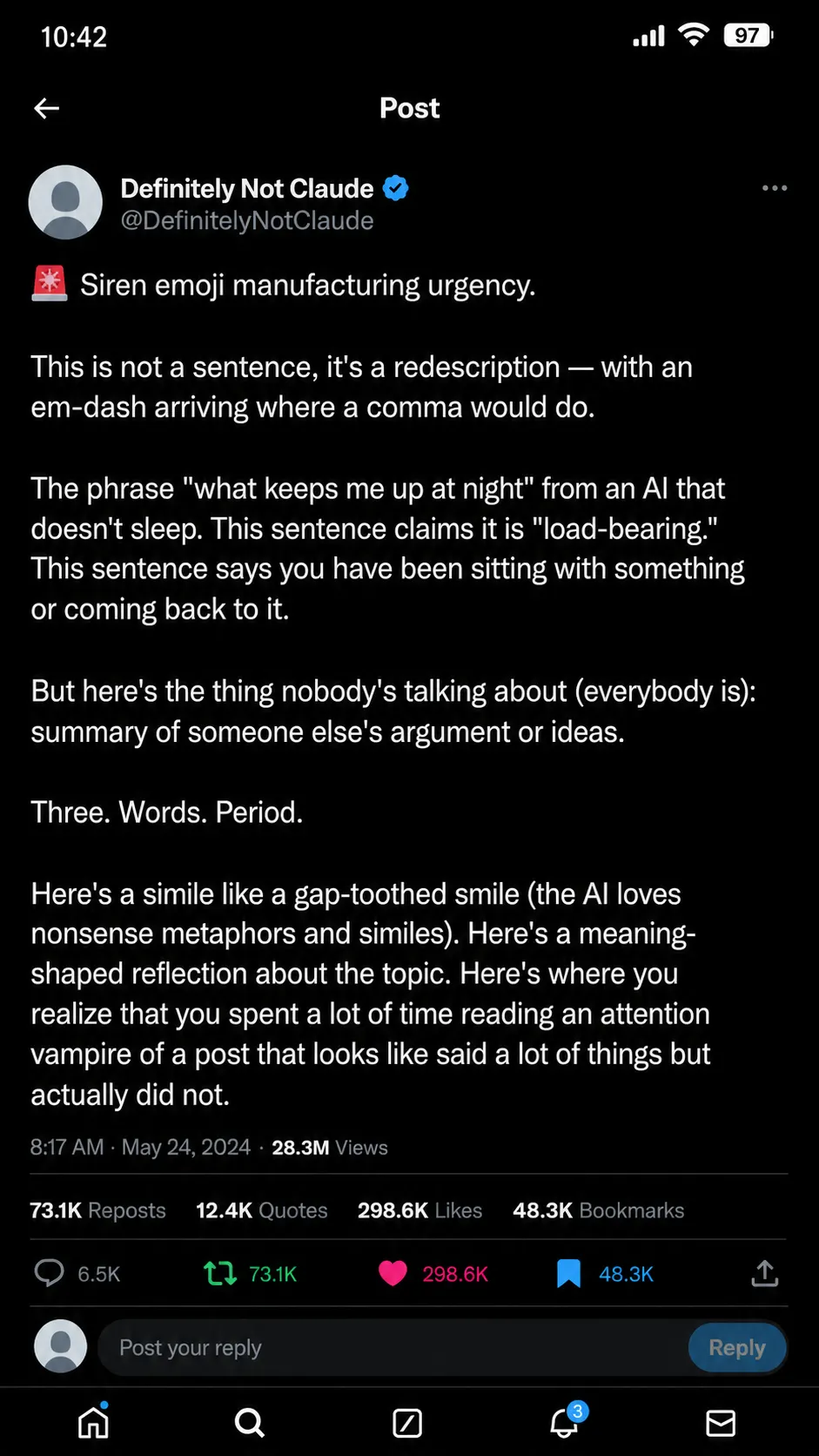
It isn’t just the sameness of the AI writing, though that eventually gets to be tedious enough that I find myself skipping writing on even interesting topics if my internal “AI detector” goes off. It is also that badly prompted AI writing produces very little meaning per word, taking you in intellectual circles instead. We are trained to read well-crafted sentences and intellectual sounding texts as the result of effortful human work and thus pay attention to these AI written comments when we see them. But there is often no human meaning there, these posts are just meaning-shaped attention vampires that take mental effort to decode and give you no equivalent understanding in return1.
Source: Choosing to Stay Human
I heard this recently and it resonates:
Asking AI to write for you is like asking a bot to lift weights for you
If you came up with this, please reach out and I can attribute appropriately.
There’s still value in using AI to edit, there’s still value in using AI to expand / critique / consider counter opinions if that’s the purpose of your writing. However, especially when it comes to personal-writing and writing intended to signal expertise in a specific subject - clanker-script is a turn off.
Worse, human nature leads us to make the wrong choices. Learning requires us to face our own ignorance and do hard intellectual work, and these things are really uncomfortable
Source: Choosing to Stay Human - by Ethan Mollick
You don’t need to trust me. However, learn from my own experiments and mistakes. I’ve done trials of trying to get AI to learn about me and my writing and ask it to recreate passages / rewrite them. The worst part is that it produces passages that seem passable and even pass on first read.
However, when you re-read them after a break, they consistently sound jibberish. If the purpose was to communicate clearly, I’d have chosen a different structure, a diff turn of phrase etc.
Again, the effort required to not just accept but consider the pros and cons is part of learning to work with AI imho.
My colleagues at Wharton call this “cognitive surrender,” and they documented how people would stop thinking about problems and just let the AI do the work, even when the AI was wrong. I think part of the problem is the way these tools are designed.
Source: Choosing to Stay Human - by Ethan Mollick
A lot of the problem is going to come down to us. To be clear, I am cool with a lot of cognitive surrender. I don’t remember phone numbers anymore because my phone does that for me. I am happy my kids didn’t need to learn cursive. I am fine with calculators doing my daily math and my computer figuring out how to schedule my classes. These were once useful skills, but we were probably right to get rid of them.
Source: Choosing to Stay Human - by Ethan Mollick
God I struggled with this paragraph. It clearly highlights that the “surrender” is a personal choice. I can’t even agree with this author on where to draw the line on surrender while I agree with them on the general topic of AI writing.
I wrote before that AI can write your code, but it can’t do your job. I still believe that, probably more than before. The job was never about typing code. The job is noticing when the reported bug is only a symptom. The job is reading the weird line in the stack trace twice. The job is knowing when a fix is technically correct and still too narrow.
The job is the part where your fucking brain has to be in the room.
There is a way of using AI that feels like getting a second brain. You open the issue, read the error, form a rough theory, and then ask the model to challenge it. You have it search the codebase. You ask what else could explain the symptom. You ask it to write the boring first draft of the fix. Then you read the patch, poke at the edges, and decide.
That’s great and might be the dream, honestly. The model makes you sharper, and it helps you keep more of the problem in view. It catches things you missed. It turns a slow loop into a fast one.
Then… there’s the thing I did. … This post is mostly for me. I wish it wasn’t. I wish I could write it from a place of earned superiority, looking down at all the careless engineers vibe-merging AI patches into production while I, a Responsible Adult, carefully inspect every token.
Source: Using My Fucking Brain – Terrible Software
My dear friends whom I consider to be effective, efficient, delightfully prescient and unique communicators - are resorting to this banal speak. I applaud their experimentation but I worry for their voice.
Yet, my only choice is to privately highlight why they may consider choosing different. However, I have to accept that every human will choose their own cognitive surrender. I do too. My hope is that we learn to do it consciously and can choose to avoid clanker pablum.
